This isn’t just a trip; it’s the moment your restless spirit finally says, “Okay, I’m going home.”
It’s where your deepest devotion meets the ultimate Himalayan challenge — and trust me, it changes everything. I still get chills thinking about it. You’re not just listening to the wind — you’re engulfed by the continuous, powerful roar of “Bum Bum Bhole!” It’s a sound that doesn’t just echo through the gorges; it thumps right in your chest. That sound is the Yatra.
Our mission is simple: to reach that majestic cave at 12,700 feet, which cradles the naturally forming, sacred Ice Shiva Lingam. It’s a miracle of nature and faith — a pillar of ice, Swayambhu (self-manifested), growing and shrinking with the moon’s cycle. For a devotee, it’s proof that Shiva lives in the mountains.
And then, the legend — the belief that Lord Shiva chose this exact spot to share the secret of immortality with Goddess Parvati fills every challenging moment with purpose. You’re not just walking a trail; you’re following a divine love story.
My journey, like yours will be, started far from those snowy peaks — in the beautiful, chaotic sprawl of Delhi. Come with me, and I’ll tell you how you get from a traffic jam to a conversation with the Almighty.
2. The Ancient Whisper – Why Every Step Matters
You can’t do this Yatra without knowing the story. It’s the invisible thread that pulls you up the mountain.
Lord Shiva, wanting absolute secrecy for His Amar Katha (the secret of immortality) with Parvati, stripped Himself of everything before entering the cave.
Think about that act of shedding — He left His beloved Nandi at Pahalgam. He took the moon from His hair and dropped it at Chandanwari. He shed the very elements that make up His being at Panchtarni.
It’s a masterclass in letting go. Every time I felt my backpack was too heavy or my knee hurt, I thought: Shiva let go of everything. What am I clinging to?
And the pigeons! The story goes that a pair of pigeons survived the fire He commanded, heard the Katha, and became immortal. I didn’t see them, but some of my fellow pilgrims swore they did. Regardless, the tale reminds you that something pure and eternal is hidden just beyond the visible world.
That’s the real reason for the trek. We walk His path, we brave the cold, we surrender our arrogance and exhaustion — hoping to catch just a whisper of that eternal truth.
3. From Delhi to the Himalayas – Mapping the Divine Heights
Delhi is your launchpad. You’re leaving the world of constant demands and noise and moving toward stillness. The logistics are the first act of faith — trusting the path will deliver you.
The total drive is about 1,000 km, but it breaks down easily:
✈️ The Fastest Way – When Time Is Short
If you’re juggling leave days like me, flying is the answer.
A quick 1.5-hour flight from Delhi to Srinagar (SXR) gets you straight into the stunning valley.
From Srinagar, take a shared taxi (2–4 hours) to the base camp — your first taste of the real Himalayas.
🚂 The Scenic Way – When the Journey Is the Destination
I highly recommend the overnight train to Jammu Tawi (JAT).
The pilgrimage starts there — you instantly meet other devotees.
From Jammu, take a taxi or bus (8–12 hours) to the base camp. It’s long, but every mile feels like purification.
4. Pahalgam or Baltal? – The First Big Decision
Once you arrive, this is the first choice that truly matters.
Route
Distance (one side)
Duration
My Takeaway
Baltal
~15 km
1–2 days
The sprint. Steep, fast, and demanding. Good for young legs and short trips.
Pahalgam
~36–48 km
3–5 days
The meditation. Longer, gentler, and infinitely more beautiful. Perfect for first-timers.
Pro Tip: Register your permit and get your mandatory Health Certificate before you leave Delhi. Don’t let paperwork stop your destiny.
5. Baltal vs. Pahalgam – A Choice of Heartbeat
🏔️ The Baltal Route – Quick and Fierce
This is the route for the marathon runner. It’s a straight shot — about 15 km one way — and you can power through it in a single, intense day (or two).
The path is rugged, steep, and narrow — only for the highly motivated.
Most helicopter pilgrims also use this route (to Panchtarni, then 6 km trek to the Cave).
Best for those short on time and strong in body.
🌲 The Pahalgam Route – Traditional and Breathtaking
This is the one that captured my soul.
It’s a 36–48 km trek, taking 3–5 days, but the ascent is gentler.
You pass through Chandanwari, Sheshnag Lake, and Panchtarni — each more scenic than the last.
Massive langars (free kitchens) line the route.
Heartfelt Advice: If it’s your first Yatra, choose Pahalgam. It’s safer, more scenic, and gives your body time to adjust. Ponies and palanquins are available if needed.
6. Living the Yatra – When Faith Carries Your Feet
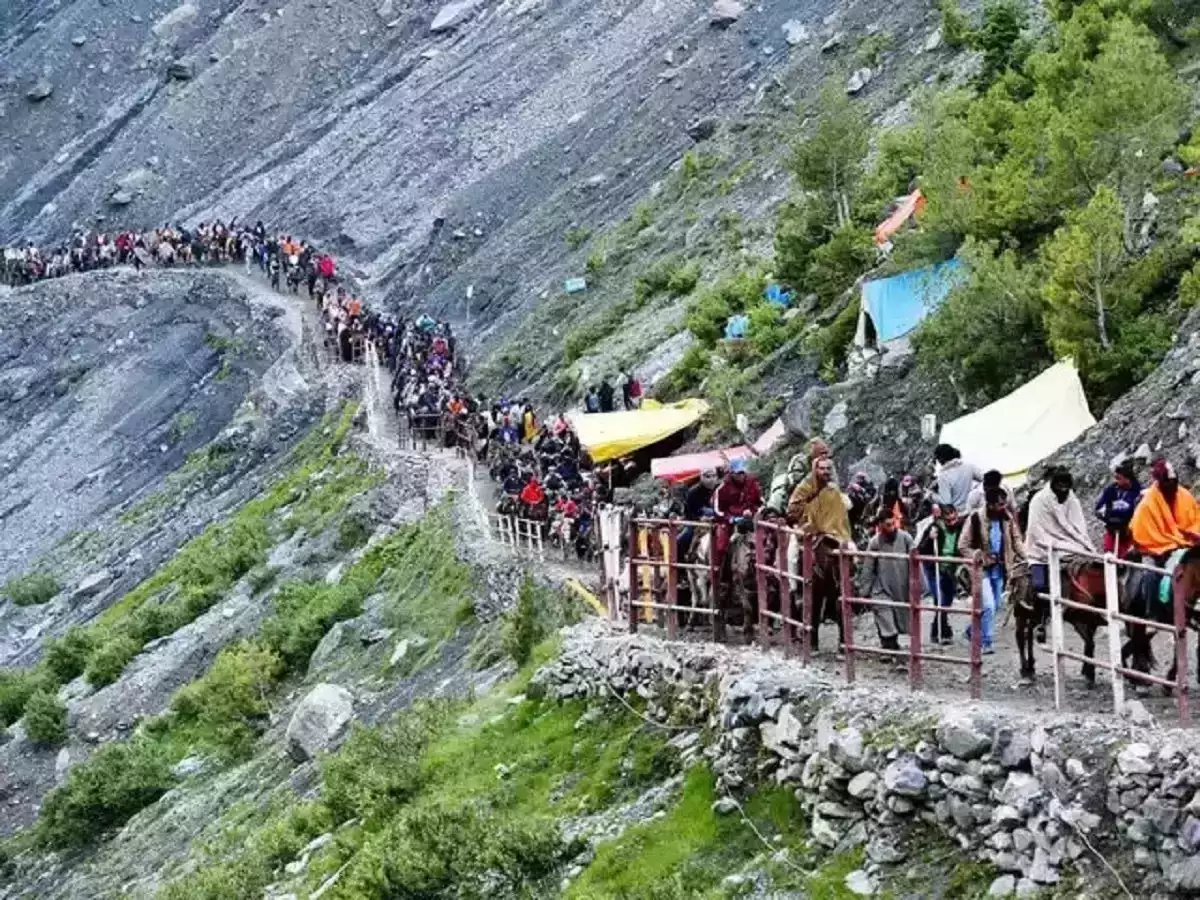
Stepping onto the trail is when the pilgrimage truly begins. You feel the collective energy of thousands of people moving toward one sacred goal.
🌄 The Base Camp Buzz
Pahalgam felt like a spontaneous city built purely on devotion. The first night, the langars were mesmerizing — steam rising from vats of dal, the rhythmic slap of chapatis, the aroma of sweet cardamom tea. You eat next to a sadhu, a student, and a grandmother — all equals.
⛰️ The Reality of the Climb
There were moments, especially near Pissu Top, where I was absolutely defeated. My lungs burned, my legs screamed, and I thought, I can’t do this. That’s when the magic happens. A total stranger — maybe a local porter, maybe another tired pilgrim — stops, offers a piece of gur (jaggery), and says, “Har Har Mahadev. You can do it.”
That’s the soul of the Yatra — camaraderie. You’re no longer individuals; you’re one body fueled by the constant chant of “Bum Bum Bhole!”
🙏 The First Glimpse
After days of effort, you round the final bend near the cave — and there it is.
The cold, massive, silent mouth of the Amarnath Cave.
Inside stands the Ice Lingam — a pillar of frozen divinity. The air is frigid, the silence absolute. You kneel, tears freezing on your cheeks, realizing that no words, no photos can prepare you for that feeling of stillness and surrender.
It’s not a sight — it’s a recognition of the divine within you.
7. Practical Love – Safety and Paperwork
Love means being responsible. Your safety is part of your devotion.
📝 Paperwork
Registration: Mandatory via the official SASB website or designated banks in Delhi.
Compulsory Health Certificate (CHC): Must be issued by an approved doctor.
Yatra Dates: Usually late June to August (Shravan month).
🛑 Safety Lessons
Acclimatize first. Spend one day just breathing at Pahalgam/Baltal.
Hydrate constantly. Water is your best friend.
Dress smart: Layer up — thermals, fleece, waterproof outer. Temperature can drop from +10°C to below freezing.
Essentials: Carry ID, permit, CHC, torch, power bank, rain poncho, and glucose packets.
8. Simple Blessings – Food and Shelter on the Trail
You learn to live simply on the Yatra — because the community provides everything with an open heart.
⛺ Stay Options
Base Camps: Hotels and dharamshalas available.
On the Route: Huge shared tents managed by trusts and NGOs.
Basic bedding and blankets.
Shared warmth and companionship.
🍽️ Langars – The Fuel of Faith
These massive community kitchens are pure seva (selfless service). You’ll get hot, simple meals — dal, rice, rotis, endless cups of chai. Eat what you’re given, smile, and thank the volunteers. Their service sustains the Yatra.
📵 The Gift of Silence
Once your phone dies, don’t panic. Only BSNL/MTNL postpaid networks may work. Tell family in advance and embrace the digital silence — it’s part of the purification.
9. The Inner Silence – Finding Yourself in Stillness
At some point on the mountain, when the noise fades and all you hear is the wind — that’s when you start listening to your own heart.
That’s where you find yourself.
10. When to Go & How to Prepare
🗓️ Timing
Season: Late June to August.
Weather: Sub-zero at night, unpredictable snow and rain.